In the first half of the 20th century the world witnessed two major wars that brought about cataclysmic changes in the world order. The First World War saw the demise of empires and kingdoms while the Second World War saw rulers cede their authority to the new world order of democracy where people’s power would be supreme.
The Second World War paved the way to creation of the United Nations with a charter that promised end to all conflicts ushering in a new era of peace through the use of diplomacy. The five permanent members of the Security Council, known as the P5, promised to uphold the principles of the UN Charter through the judicious use of their veto in favour of diplomacy rather than use of force to end conflicts and wars.
Unfortunately, the second half of the 20th century witnessed wars waged or instigated by the P5 gathering strength, not only to settle old conflicts but also to exhibit military supremacy in the new world order. The result was the Cold War and a race for more dangerous weapons of mass destruction, including nuclear warheads and deadly chemical weapons.
The UN, under the astute leadership of its secretary generals, tried to fend off major wars for a good part of its existence to date. It managed to get its members to agree on several treaties in the hope that they would be able to promote peace rather than start wars that could destroy humanity. Among them were the disarmament treaty, the nuclear non-proliferation treaty, and the treaty on the ban on use of chemical weapons.
However, the 20th century did not end in peace and security for all as enshrined in the UN Charter. While the Cold War ended with Russia giving up its territorial ambitions and allowing its satellite countries to regain their independence, the United States embarked on new adventurism in Iraq, Afghanistan, Libya, Syria, Lebanon and Iran. While the UN celebrates eighty years of its existence, a quarter of the 21st century has passed with peace still remaining elusive as the world has been embroiled in more deadly conflicts in Palestine and its Middle Eastern neighbourhood.
The alternative to war is a peace that can be achieved through diplomacy at its best. Pundits have defined diplomacy as the management of international relations by negotiation and skill in dealing with others. Today’s diplomacy has had to adjust not only to the rapid speed of the growth and use of deadly weapons, but also to revolutionary technological challenges while dealing with old and new problems and adversaries. The new challenge for states is tackling constant news outbreaks needing rapid response, the shifting of diplomatic positions requiring quick re-positioning on issues of urgent national interest, and global challenges requiring adjustments and repositioning in conducting international relations, as well as dealing with its own citizens under changed circumstances.
Conducting negotiations and suggesting necessary changes in relations challenging the status quo necessitates the existence of a robust and well-defined foreign policy. The formulation of foreign policies and their implementation not only depend on the political philosophy of a country’s leadership and its equation with other countries and foreign leaders, but also the expectation and hopes of the general masses for a peaceful and happy relations with the outside world: a world where they are treated with respect and security, where they are recognised as citizens of their country with equal rights. The policy requires buy-in of all shades of political entities and the public within the country itself. That is why the success of a foreign policy cannot be guaranteed by framing powerful policies alone, but needs a powerful leadership for its implementation and the support of its populace.
Bangladesh’s foreign policy dictum has failed to define how the state would respond when its peace and security is threatened, or in the case of a sudden, unexpected change in the international arena that may have wider ramifications for the future of the country. The vagueness of the statement “friendship towards all, malice towards none” makes it difficult for diplomats to meet both visible and invisible threats when they occur. There is an urgent need to have the policy grounded on a solid base with further elaboration for both diplomats and the public to understand, see, and feel its value; a definition that draws a parameter for conducting international relations and which is clearly understood by friends and foes alike.
While diplomacy remains key to the resolution of problems, it cannot make up for the absence of a well-defined policy for negotiation with partners and adversaries. Diplomats dealing with others in adverse situations must have the confidence that the government of the day will back the negotiator to the hilt. The negotiator and the spokesperson in diplomatic situations have to be in perfect synch with the prime policy maker speaking in the same language in different arenas. Any serious diversion from the stated procedure may lead to disaster.
At the very least, it can give rise to misunderstandings and reinforce a blame-game culture in serious situations. That is why it is important to have a framework to be followed by all, even for those who may or may not be directly involved or engaged in the process, to have an outcome where there is a complete understanding of the policy and a better synchronisation of various activities that make up the whole. People’s conscious understanding of a diplomatic problem and its solution is reinforced by the messaging from news outlets, which have an important role to play in building awareness
Use of appropriate language is extraordinarily important in diplomatic discourse and negotiation. The trick is in conveying a harsh message to an adversary with a soft effect that will protect the political and diplomatic standing of both parties. Bangladesh has gone through a painstaking revolution and is now engaged in charting out a more just, fair, stable and peaceful country for all. The people are receptive to the idea of change and willing to put their bet on better policy formulation. We cannot let this opportunity pass. Now is the time to define our foreign policy.
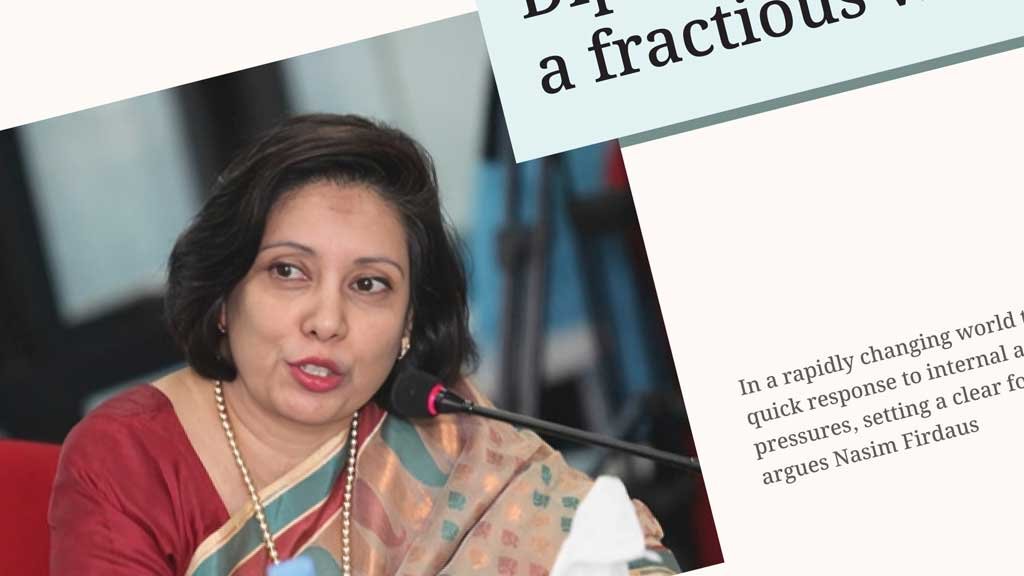
[Nasim Firdaus is a career diplomat (Bangladesh’s first female foreign service officer) who rose to the rank of secretary and served as ambassador to several countries]