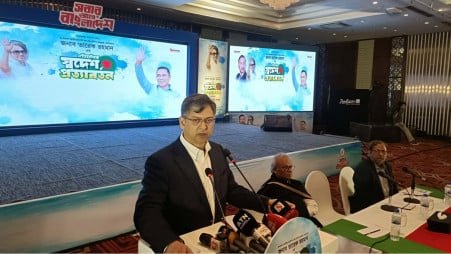
BNP Standing Committee Member Salahuddin Ahmed has described the recent arson and vandalism at the offices of Prothom Alo and The Daily Star as a “shame for the nation,” saying the world witnessed the destruction of these newsrooms.
Speaking at a views-exchange with editors and media personalities at the Radisson Blu Dhaka Water Garden in the capital today (21 December), the BNP leader argued that the gravity of the incident cannot be mitigated through mere expressions of regret or apologies.
From democracy to ‘mobocracy’
Salahuddin placed the primary responsibility on the interim government, questioning the authorities’ failure to act despite reportedly “having prior intelligence” regarding the attacks.
Whose hands are we entrusting the state apparatus to? The role of those tasked with ensuring a neutral election is now being questioned
Salahuddin Ahmed, member, BNP Standing Committee, on law enforcement agencies which were slow to respond to the attacks
“The world has seen Prothom Alo and The Daily Star being set on fire. It is a matter of great shame for us,” he said.
He alleged that law enforcement agencies were slow to respond, reportedly arriving one to two hours after they were notified of the violence.
“Whose hands are we entrusting the state apparatus to? The role of those tasked with ensuring a neutral election is now being questioned.”
The BNP leader expressed concern over a rising trend of targeting media outlets, noting that “mobocracy” appears to be superseding the democratic transition the people fought for.
Attributing such lawlessness to the “government’s weakness,” he said, “We wanted democracy, but it has turned into mobocracy. These incidents must be suppressed with an iron fist.”
Salahuddin emphasised that for democracy to be institutionalised, constitutional bodies must be strengthened so they can serve as “safeguards” for the people’s rights.
The fourth pillar
Addressing the editors, news chiefs, and media personalities present, Salahuddin acknowledged the role of the media as the fourth pillar of the state.
While noting that individuals within the profession may have diverse political leanings, he urged journalists to prioritise the nation’s interests above all.
“We want to forget the past, but we must remember what the fascist forces have done,” he remarked.
He assured the media that if the people entrust the BNP with the responsibility of governing the state, the party will offer its maximum cooperation to the press.
The discussion was organised by the BNP ahead of the scheduled return of the party’s acting chairman, Tarique Rahman, on 25 December.
Salahuddin noted that the public expects his homecoming to bolster the foundations of democracy in Bangladesh after 18 years of “painful exile”.
The event was attended by editors of leading national dailies, online news portals, and heads of radio and television newsrooms.